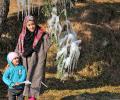
'Chillai-Kalan' will end on January 31. The cold wave continues even after that in Kashmir with a 20-day-long 'Chillai-Khurd' (small cold) and a 10-day-long 'Chillai-Bachha' (baby cold).

Srinagar recorded a low of minus 3.2 degrees Celsius, an increase of two degrees from the previous night's minus 5.2 degrees Celsius, a spokesman for the MET department said in Srinagar.

Rain and snow on the first day of Chillai-Kalaan is locally seen as a good omen and a precursor to plenty of snow.

The 40-day period marks the harshest phase of the winter in the Kashmir valley.

The Valley has witnessed heavy snowfall and sleet over the past two days.

The national capital was in the grip of a cold wave, with the sun largely obscured by clouds and pollutants lingering in the atmosphere, leading to reduced visibility. At least 129 flights were cancelled at the Delhi airport on Saturday due to dense fog, according to an official.

This was the lowest minimum temperature recorded in the city since 1991, when the mercury had fallen to minus 11.4 degree Celsius.

Kashmir Valley reeled under sub zero temperature as mercury in summer capital Srinagar was recorded at minus 3.9 degrees Celsius and in cold desert of Ladakh it remained under the 10 degrees mark freezing most water bodies and fringes of famous Dal lake.

The Meteorological Department has forecast rains or snow over five days from Monday.

Cold wave conditions continued unabated in Kashmir Valley with minimum temperatures hovering below freezing point, causing severe problems to the residents.

The lowest temperature ever recorded in Srinagar was minus 14.4 degrees Celsius in 1893.
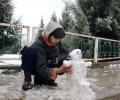
Kashmir Valley on Thursday experienced fresh snowfall with most places, especially the plains, witnessing the first snow of the season, breaking the prolonged dry spell at the fag end of 'Chillai-Kalan', the 40-day period of harshest winter. While the snowfall was mild and brief, it nonetheless brought much joy to the locals.

The snowfall started during the night at most places and early in the morning at few places, the officials said. They said while some areas in north Kashmir received light snowfall, most areas in central and south Kashmir experienced moderate snowfall.

Operations at the Delhi airport remained normal. However, three flights were returned or diverted to the Delhi airport due to bad weather in Chandigarh, Varanasi and Lucknow on Tuesday night.

The all-time low recorded in the month of December in Srinagar is minus 12.8 degrees Celsius on December 13, 1934.

Mercury plummeted in Kashmir Valley on Thursdayafter a slight respite for few days, dropping further below the freezing point with Kargil recording a new low of minus 15.8 degrees Celsius this season.

Leh in Ladakh region recorded the lowest temperature this winter as mercury plummeted to minus 17.1 degree Celsius on Tuesday night, a meteorological department official said.

Mercury continued its free fall in Kashmir division as Leh in Ladakh region recorded the coldest night this winter with a minimum temperature of minus 16.3 degrees Celsius.

On December 7, 1990, Srinagar had recorded a low of minus 8.8 degrees Celsius.

The cold conditions returned in Kashmir division as the night temperature in most places, including Leh, plunged further below the freezing point followed with clear skies and unusual sunny days.

The minimum temperature across the Kashmir Valley and Ladakh Union Territory stayed several degrees below the freezing point, intensifying the cold wave in some areas in the region, an official of the Meteorological Department said. He said Srinagar city recorded the low of minus 6.2 degrees Celsius last night, down from minus 5.8 degree Celsius the previous night.

The bone-chilling cold returned as the night temperature plunged below the freezing point across Kashmir division after a brief respite owing to the rains in plains and snowfall in high altitude areas early this week.

Kashmir remained cut off from rest of the country for the fourth consecutive day on Wednesday as the arterial Jammu-Srinagar national highway and the Mughal road remained closed, while air traffic was suspended due to heavy snowfall across the valley.

There was some respite in cold conditions in Kashmir as the mercury went up by several degrees at most places after four days of virtual free fall.
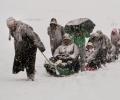
Kashmir witnessed the season's heaviest snowfall.
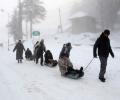
The 40-day period of harshest winter ended on Saturday

Leh and Kargil towns in Ladakh region recorded the season's coldest night as the cold wave intensified in Jammu and Kashmir after a slight respite for few days.

Cold wave tightened its grip on Kashmir Valley ahead of the onset of 'Chillai-Kalan' -- the 40-day harshest winter period -- with the summer capital Srinagar and Leh town recording the coldest night of the season.

Normal life was thrown out of gear in Kashmir on Saturday as most areas of the valley received snowfall, disrupting flight and railway operations and also leading to the closure of the Srinagar-Jammu National Highway, officials said.

The 40-day period of harshest winter in Kashmir known as 'Chillai-Kalan', began on Monday as the mercury dipped to season's lowest at several places including Srinagar, the summer capital of Jammu and Kashmir.

North India was in the grip of intense cold with 40 days of harshest winter period 'Chillai-Kalan' beginning in Jammu and Kashmir on Saturday and icy winds sweeping across the plains.
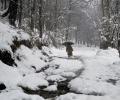
The crucial Jammu-Srinagar highway has been blocked

Fresh snowfall was recorded in the higher reaches of Kashmir overnight while the plains received rains, even as the mercury stayed above the freezing point at most places.

Intense cold conditions prevailed in parts of north India on Sunday as the mercury plummeted to minus 12.6 degrees Celsius in Leh, while the Kashmir valley braced for possible snowfall over two days from Monday
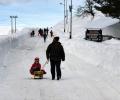
Landslides have occurred near Ramban and Battery Cheshma which have forced the closure of the highway.
Cold wave conditions remained unabated as the night temperature across Kashmir continued to stay below the freezing point with forecasts for dry spell.

Delhi saw seven cold wave days in January 2020, while it did not record any such day last year.

Dense to very dense fog engulfed the Indo-Gangetic plains, including Delhi, for the second morning on the trot on Tuesday, lowering visibility to 50 metres in the city and affecting road traffic and train movement.

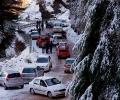
The high hills of Himachal Pradesh received snowfall leaving tourists delighted.
 © 2026 Rediff.com - Advertise with us - Disclaimer - Privacy Policy - Sitemap - Feedback - About us - Terms of use - Grievances